Hot Alignment & Thermal Growth
Cold alignment is the easy part. Hot alignment is what keeps the machine running — on hot turbines, hot compressor trains, and hot service pumps.

- 1.Key takeaways
- 2.Cold alignment is the easy part
- 3.Start with the OEM's cold offset, not zero
- 4.Driver and driven don't grow the same
- 5.Methods of measurement: lasers, dials, and continuous monitoring
- 6.The 120-180 minute post-trip window
- 7.Couplings hide misalignment
- 8.When alignment problems show up at the seal
- 9.The takeaway
Key takeaways
- Every piece of hot rotating equipment has a published thermal growth figure. Your job is to set cold indicators to offset those numbers — not to center on zero.
- Driver and driven don't grow the same. On a turbine-compressor train, the turbine grows differently than the compressor, and each foot grows differently again.
- Re-shoot hot inside the 120-180 minute post-trip window before the machine cools and your hot readings turn into garbage.
- Hot service pumps are an asymmetric problem. The pump body grows on hot piping; the motor stays at ambient. API 686 isn't optional.
- Couplings hide misalignment. They transmit force into bearings without indicating anything at the coupling face. Vibration signatures, bearing temps, and wear-metal trends will tell you before the coupling does.
- The seal won't save you from misalignment. The seal you specified perfectly per API 682 will eat the wear and leak first.
Cold alignment is the easy part
Anyone who's worked on a hot steam turbine, a gas-turbine driven centrifugal compressor, or a high-temperature pump train knows the rule: if you only align cold and call it done, you're shipping a misalignment problem into operation.
The physics aren't complicated. Steel grows when it heats up. Different parts of a rotating equipment train heat up at different rates and to different temperatures. The bearing housings, the casings, the piping, the foundation — every component has its own thermal growth curve, and the coupling sits at the intersection of all of them.
Cold alignment puts the train in alignment at ambient temperature. Hot alignment is what keeps it in alignment at operating temperature. Two different jobs. The shop that treats them as one job is the shop whose seals leak inside six months and whose bearings need rebuilds inside a year.
Start with the OEM's cold offset, not zero
Every piece of rotating equipment with a hot service has a published hot growth figure. A Solar Centaur 40 has one. A Frame 7 has one. An API 610 hot pump has one.
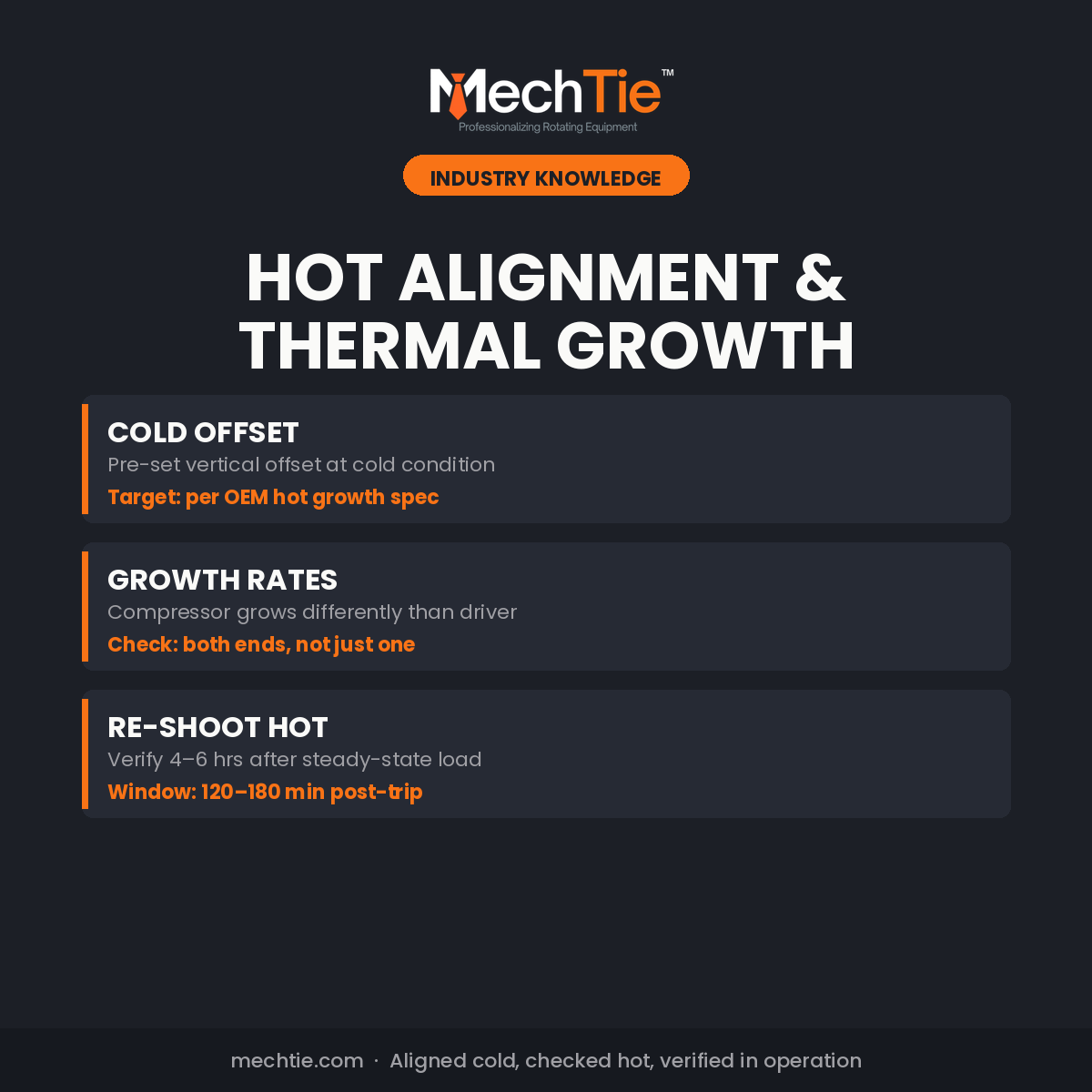
Your job is to set the cold indicators to offset those numbers — so that when the machine heats up and grows, it grows into alignment, not out of it. If you're centering cold, you're guaranteeing misalignment hot.
Read the OEM data sheet carefully. You're typically looking at four vertical growth numbers, not one — driver inboard foot, driver outboard foot, driven inboard foot, driven outboard foot. Each grows differently because the bearing housings sit at different distances from the heat source. On a typical turbine-compressor train you might see driver outboard at 0.012", driver inboard at 0.018", driven inboard at 0.022", driven outboard at 0.014". Different number for each.
Plug those four numbers into your alignment software (or your cold-offset calculator if you're working dial indicators) and you'll get the cold positions you should be aiming for. Not zero. Offset.
Driver and driven don't grow the same
On a typical turbine-compressor train, the turbine end grows differently than the compressor end. The turbine sees direct heat from steam or combustion gas. The compressor casing grows mostly from process fluid temperature, which is usually different.
Hot pumps are even more asymmetric. The pump body sits on hot piping and grows vertically with the piping's thermal expansion. The motor sits on a baseplate at near-ambient temperature and barely grows. Net result: pump rises, motor doesn't, and your coupling pulls out of true the moment the unit reaches operating temperature.
That's where API 686 comes in. The standard exists specifically to address pump installation and alignment under hot service conditions. It covers grouting, baseplate stiffness, soft foot checks, piping strain limits per API 610 nozzle loading, and the cold-offset procedure that handles asymmetric thermal growth between pump and driver. If your shop doesn't reference API 686 on hot pump work, the alignment will go sideways within the first thermal cycle.
Methods of measurement: lasers, dials, and continuous monitoring
Three ways to capture alignment in 2026, in roughly the order most shops use them:
Reverse indicator and rim-and-face dial indicator setups are still the workhorses on day-to-day work. Cheap, durable, well-understood by anyone with field time. The downside is repeatability — your soft foot, your indicator sag correction, and your reader bias all add error. A good tech with dials can match a laser; a careless tech with dials will be off by 5+ mils.
Laser alignment systems (Easy-Laser, Pruftechnik Optalign, Fixturlaser) have replaced dials on most modern shops. They handle the math, run repeatable shots, and output the cold-offset corrections directly. A senior tech with a laser on a turbine-compressor train moves twice as fast as the same tech with dials.
Continuous laser monitoring is the option for critical turbines that can't tolerate post-trip alignment work. The system reads alignment in real time during operation. Expensive, only justified on high-criticality machines where the production cost of a planned outage exceeds the equipment cost of the monitor.
Pick the tool that matches the equipment criticality and the shop's competence. A junior tech with a laser will get a better answer than a junior tech with dials. A senior tech with dials will beat a junior tech with a laser. The skill matters more than the tool.
The 120-180 minute post-trip window
You have about 120 to 180 minutes after a hot trip before the machine has cooled enough that your hot readings are garbage. If the unit trips at 3 AM, somebody's getting the call — this isn't a next-morning job.
What you're capturing in that window is the actual position of the train at operating temperature. You compare it to where you set it cold. If the cold-offset calculation was right, the hot reading should land at zero (or close to it). If it doesn't, you have data telling you what to adjust on the next cold setup.
The other option is the continuous laser system mentioned above — used on critical turbines where the post-trip window isn't reliably available. But on most day-to-day work, the 2-hour post-trip window is what you've got. Plan crew availability accordingly.
Couplings hide misalignment
The most common mistake on a hot job: assuming a coupling that looks fine cold is aligned hot. Couplings are rigid for the job — they'll transmit misalignment into bearings all day without showing you anything at the coupling face.
What will tell you, in order of how early in the failure mode each signal shows up:
The vibration signature reveals it first. A misaligned train shows characteristic 2X running-speed vibration on a coastdown sweep. The harmonic pattern alignment makes is distinct from balance problems and structural problems — we covered the diagnostic patterns in Reading a Coastdown Bode Plot Before You Trim Balance. If you're chasing high vibration on a hot machine and you haven't checked alignment, you're chasing the wrong problem.
Bearing temperatures show it second. Misaligned trains run hotter at the bearings closest to the coupling. A 10-15°F rise on the coupling-end bearing relative to the outboard bearing is a flag. On a turbine the temp will trend up over weeks; on a hot pump it can show up within a single thermal cycle.
The wear-metal trend in the bearing oil shows it third. Misalignment shows up as iron and copper increases on routine oil samples weeks before it shows up at the coupling. We walked through how to read those samples in Reading a Journal Bearing Oil Report — the same iron-and-copper pattern that points at babbitt wear from journal bearing problems can also point at misalignment-driven bearing damage.
If you're checking alignment on equipment that runs over 200°F at the bearing housings, cold-only alignment isn't alignment — it's a guess.
When alignment problems show up at the seal
A misaligned hot pump dumps the misalignment into the bearing housing first, then into the seal chamber. The seal will run a few mils of shaft deflection for a while, but the inboard face will eat the wear and the leak will follow within months.
The seal you specified perfectly won't save you from misalignment. The seal does the job the seal does. Alignment is a separate problem and you have to solve both.
This is why hot-service work has to be done as a system, not a sequence of independent decisions. The plan, the seal, the alignment, the foundation — they're paired problems and they have to be right together.
The takeaway
If you're working hot service rotating equipment, you have two alignment jobs: get the cold setup right with the OEM's published offsets, and verify hot inside the post-trip window. Skip either one and you're guessing.
The shops that get this right invest in the OEM data sheets, the laser systems, and the discipline to send a tech back at 3 AM after a trip. The shops that don't get this right blame the seal vendor when the seal leaks at month four.
What's your go-to method for capturing hot readings — laser, dial indicators, continuous monitoring, or something else? And what's the worst case of inherited cold-only alignment you've had to argue out of?
Are you an alignment specialist? Build your verified profile on MechTie — list your laser-alignment OEM training (Easy-Laser, Pruftechnik, Fixturlaser), your API 686 field hours, and your hot-service equipment history. Plants searching for specialists with documented hot-alignment experience will find you because your record matches what they need.