Hot Service Pump Alignment: What Changes When the Pump Runs Hot
Hot service pumps grow differently than their motors — why cold-only alignment ships a misalignment problem into operation and the seal always tells you first.

Hot service pumps don't grow the same way turbines do, and most field techs default to turbine alignment patterns when they shouldn't.
API 686 is the standard. It's not optional, but a lot of shops treat it like it is.
Three things that change when the pump runs hot
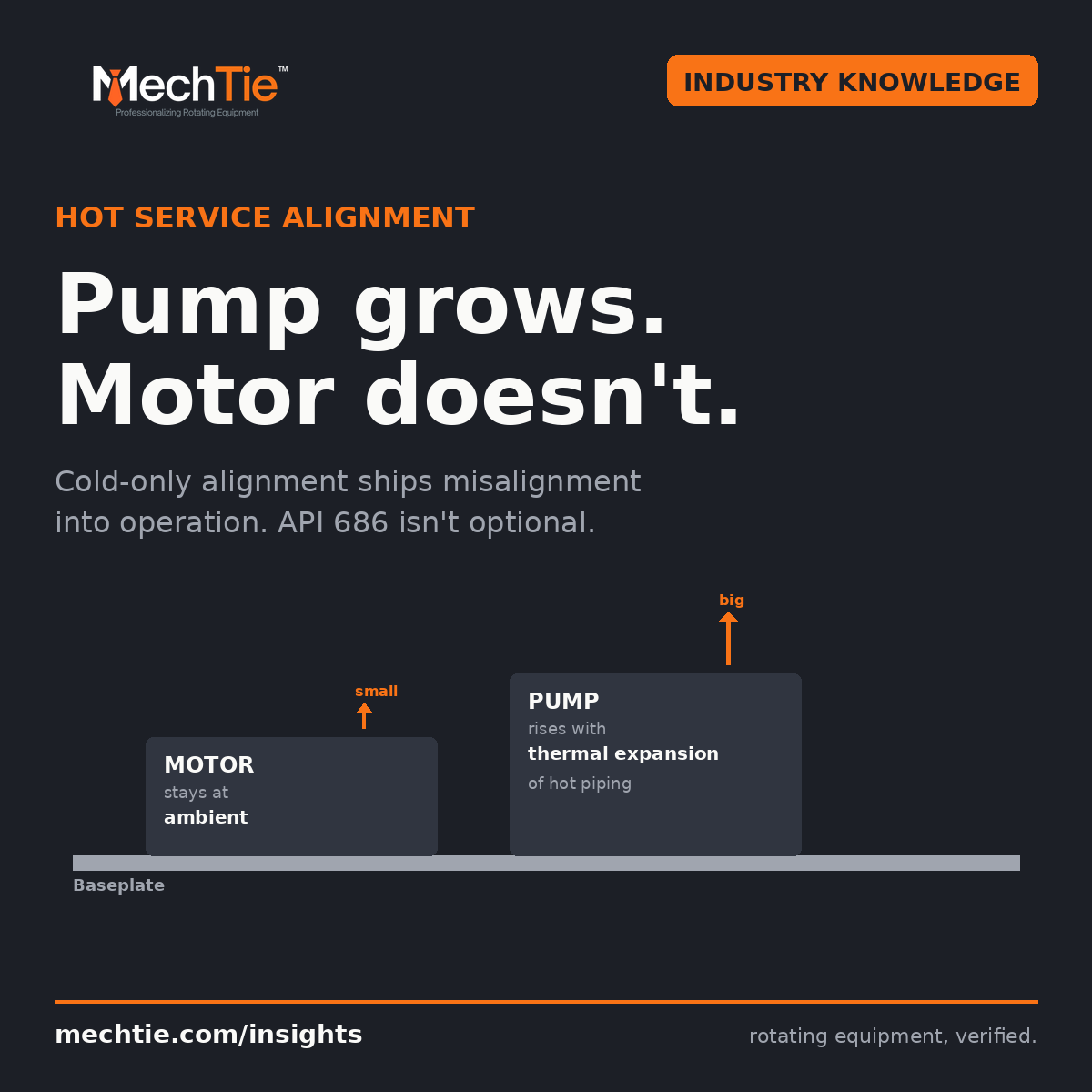
Driver and driven grow differently
On a turbine train you'd already account for this — on a pump, techs sometimes don't. The motor stays close to ambient. The pump body sits on hot piping and grows vertically more than the motor does. Net result: pump rises, motor doesn't, and your cold-zero alignment is pulling the coupling out of true the moment the unit reaches operating temp.
Piping load amplifies the offset
A hot service pump is bolted to piping that's also growing. If the pump spool piece isn't taking the thermal expansion, it's transferring force to the pump nozzles — which lifts or twists the casing in ways that show up as misalignment at the coupling. Spec API 610 nozzle loading limits and hold the engineering team to them.
The 120–180 minute hot re-shoot window
Same as the turbine playbook — pull a hot reading inside the post-trip window before the pump cools. On critical hot services, spec a continuous laser system; on day-to-day work, the post-trip window is what you've got. We covered the full hot alignment procedure in Hot Alignment & Thermal Growth — the same 120-minute rule applies to pumps and turbines alike.
What this means for the seal
A misaligned hot pump dumps the misalignment into the bearing housing first, then into the seal chamber. The seal will run a 5-mil shaft deflection for a while, but the inboard face will eat the wear and the leak will follow.
The seal you specified perfectly per API 682 won't save you from misalignment. They're paired problems and you have to solve both.
If you're running an API 610 hot pump and the alignment was set cold-only, you're shipping a misalignment problem into operation — and the seal will tell you about it before the coupling does.
Are you a pump or alignment specialist? Build your verified profile on MechTie — list your API 686 experience, your hot-alignment field hours, and your OEM authorizations. Plants searching for alignment specialists on hot service work will find you.