Reading a Journal Bearing Oil Report
How to read a journal bearing oil analysis report: what wear-metal trends, viscosity data, and particle counts tell you before you call for an outage.

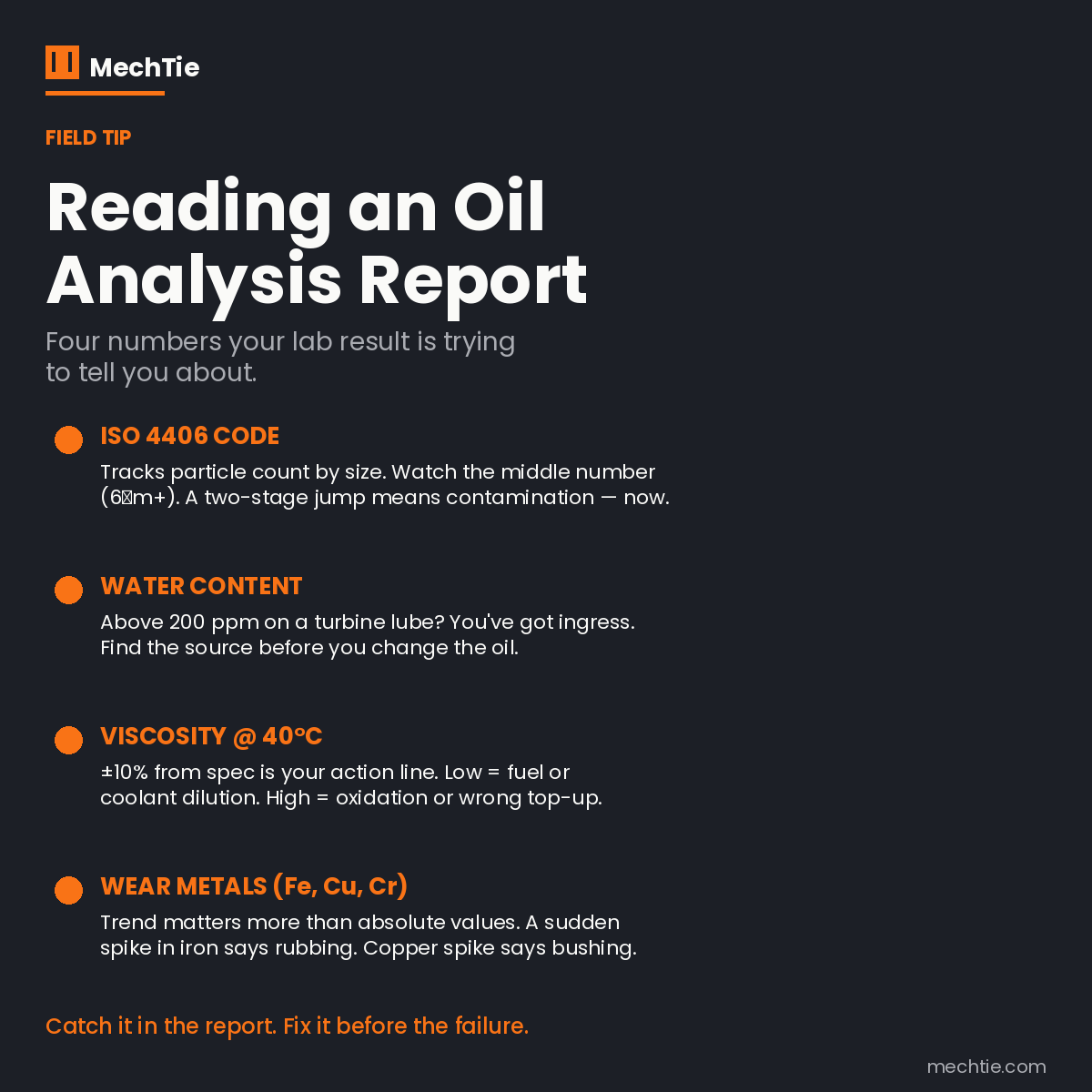
Most field guys check iron and move on. But a journal bearing oil report tells you a lot more if you know where to look:
Iron (Fe) — trending up?
Rising iron PPM usually means babbitt contact or wear. On a steam turbine journal bearing, I start paying attention north of 30 ppm and get aggressive above 50. Don't just compare to the threshold — compare to the last three samples. Trend matters more than the absolute number.
Copper (Cu) — sudden jump?
Copper comes from bearing cages, thrust pads, or — often overlooked — cooler tubes leaching into the oil. A spike without iron usually points at the cooler, not the bearing. Pull a sample from the cooler discharge if you're unsure.
Water content — above 500 ppm?
That's a change-out and a seal investigation. On outdoor units, condensation from swing-shift temperature changes is the usual suspect. On indoor skids, it's a gland seal or a cooler tube. Either way, water in the oil chews up babbitt and accelerates oxidation.
The catch most people miss
A "clean" report with low particle count but rising viscosity. That's oxidation from heat or aeration, and it means your bearing is running hotter than it should — even if the temp gauge doesn't show it yet.
The lab gives you numbers. Your job is to read them in context: equipment history, operating conditions, last oil change, and what's normal for that specific machine. That's the difference between a tech who runs samples and a tech who actually prevents failures.
What's the most useful oil analysis catch you've made in the field?
#RotatingEquipment #OilAnalysis #ReliabilityEngineering #MechTie #PredictiveMaintenance