What a Senior Mechanical Seal Specialist Actually Makes in 2026
Real numbers from the field — base hourly, per diem, travel time, and the credentials that compound the rate.

- 1.Key takeaways
- 2.Base hourly: $85–$130/hr
- 3.Per diem and travel: where the rest of the day rate lives
- 4.What the all-in day rate looks like
- 5.The credentials that actually move the rate
- 6.Required floor
- 7.Rate movers
- 8.The compounder: documented work history tied to specific equipment
- 9.The pattern that pays: diagnostic skill over rebuild speed
- 10.How MechTie helps with rate transparency and the work that matches your profile
Key takeaways
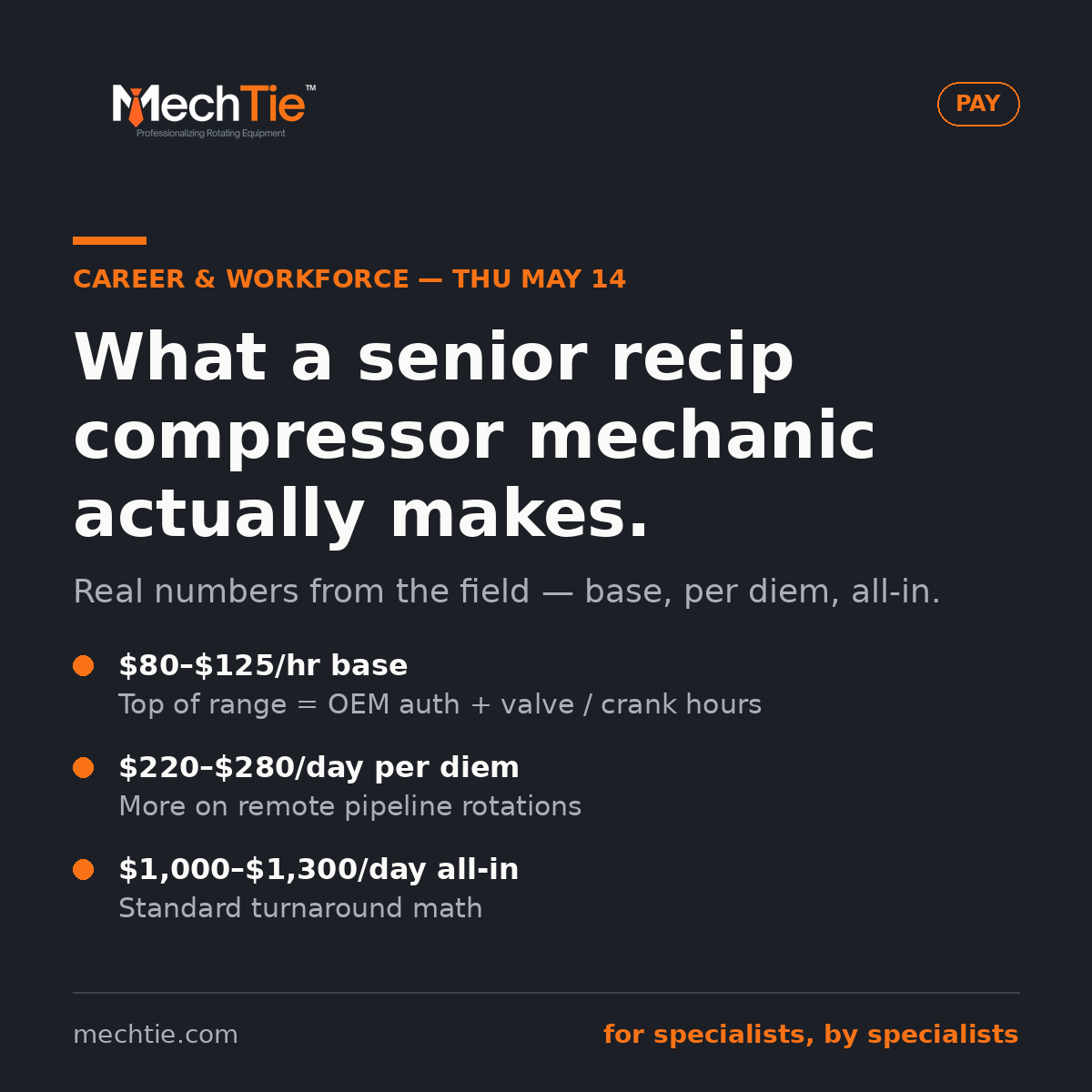
- Base hourly for a senior mechanical seal specialist runs $85–$130/hr in 2026, with the top of the range gated by OEM authorizations and verified Plan 53A/B field hours.
- Per diem on standard refinery and chemical plant work is $220–$280/day, with $300+ in remote markets like the North Slope or Permian Basin during turnaround season.
- All-in turnaround day rate (base + per diem + portal-to-portal travel + OT) lands in the $1,150–$1,400/day range. A 14-day outage works out to $16,000–$20,000 gross.
- The credentials that move the number aren't generic — they're API 682 OEM authorization, documented Plan 53A/B field hours (not classroom), and a current TWIC plus the safety stack the site requires.
- The pattern that compounds: diagnostic skill (read the service, pick the right plan) bills more than rebuild speed. Specialists who can prevent the wrong-plan failure get called for the next outage.
Base hourly: $85–$130/hr
The wide range tracks two variables: factory training and verified field hours.
A senior pump mechanic with a few years of seal work and no specific OEM authorization will see $85–$95/hr on standard refinery and chemical plant call-outs. Add factory training from one of the four majors — John Crane, EagleBurgmann, Flowserve, or Chesterton — and the rate moves to $100–$115/hr. Add documented dual-seal field hours (specifically Plan 53A or 53B commissioning, troubleshooting, and rebuild work, not just classroom certification) and the top of the range opens up to $120–$130/hr.
The premium for OEM authorization is real because the work itself is gated. A site running a John Crane Type 8B-1 dual seal on light hydrocarbon service often won't accept warranty work from a non-authorized tech. The plant doesn't want to void coverage, and the insurer doesn't want the liability. That gates the population of specialists who can take the job — and gated supply pulls the rate.
Per diem and travel: where the rest of the day rate lives
Standard per diem on most refinery and chemical plant work in 2026 runs $220–$280/day, broken out as M&IE plus actuals on lodging. Remote markets pull more: North Slope rotations, Permian Basin during spring or fall turnaround season, offshore — anywhere with a small specialist labor pool and high housing costs — runs $300–$400/day on per diem alone.
Travel time should be portal-to-portal and billed as work hours. We covered the math on this in detail in What the Road Actually Pays — the same accounting applies to seal work as to turbine field service. If your shop isn't billing your travel day, that's a conversation, not an acceptance.
What the all-in day rate looks like
For an OEM-authorized seal specialist with documented Plan 53A/B field hours, working a 14-day outage at a refinery during turnaround season, the all-in day rate runs $1,150–$1,400. Math:
- 10 hours/day × $115/hr base = $1,150 base
- 2 hours OT × $172.50/hr (1.5x) = $345 OT
- $250/day per diem
- = roughly $1,745/day on a long shift; closer to $1,150 on a tighter 8-hour day with portal-to-portal travel only
Across a 14-day outage, that's $16,000–$20,000 gross before tax. Run two of those a year as the spring and fall turnaround anchors, fill in the rest with commissioning, rebuilds, and consulting hours, and you're at $200K+ on a normal year as a contract specialist. The shop W-2 path with the same equipment authorizations runs $130K–$180K base plus benefits, depending on overtime patterns.
The credentials that actually move the rate
Generic certifications get you in the door. Specific ones move the rate.
Required floor
TWIC for any port, refinery, chemical plant, or MTSA-regulated facility. OSHA 30 for general construction safety. H2S Alive for any sour service work. Confined space and fall protection per site requirements. None of these add to your rate; missing any one of them takes you off the call list.
Rate movers
API 682 OEM authorization from John Crane, EagleBurgmann, Flowserve, or Chesterton. This is factory training, typically 1–2 weeks of classroom and lab, often paid for by your employer or self-funded if you're a contractor. The certificate plus the warranty-preserving work authority is what moves the rate from $95/hr to $120/hr.
Plan 53A and 53B field hours, documented and verified. The field hours matter more than the classroom. A specialist with 200+ hours on Plan 53B systems — pressurized barrier seals on hazardous service — commands a 15–20% premium over a generalist seal mechanic on the same call-out. The reason is the same as the OEM authorization: low supply of people who've actually done the work under live conditions, plus high consequences of getting it wrong. We walked through what each API 682 plan does and where each one gets misused — the diagnostic ability to walk up to a pump and identify whether a Plan 11, 23, 32, 52, or 53A is the right fit is what plants are actually paying for, not just the wrench-turning.
NFPA 70E for any work near energized equipment. MSHA Part 46/48 for mining-adjacent facilities (cement plants, ore processing, gypsum operations). These open access to job sites that pay a premium because fewer techs are credentialed to enter them.
The compounder: documented work history tied to specific equipment
The credentials get you the call. The work history closes the rate negotiation. A profile that says "API 682 trained" is one credential. A profile that says "Plan 53B field hours: 340, documented across Sulzer MBN, Flowserve HPX, and ITT Goulds 3196 services since 2022, with peer endorsements from the lead millwrights at four sites" is a hireable specialist. Plants can search for that specific work history; staffing agencies can't fake it.
The pattern that pays: diagnostic skill over rebuild speed
The shift that's happened in seal work over the last decade is that plants are paying more for diagnostic skill and less for raw rebuild throughput.
Twenty years ago, the seal mechanic who could rebuild four cartridge seals in a shift was the prized specialist. Today, the seal mechanic who can walk up to a pump that's eating seals every six months and tell the reliability engineer "this is a Plan 32 service with a Plan 11 spec — change the plan or replace the seal again next quarter" is the one getting called for the next outage and the next one after that.
The economic reason: a turnaround call-out is $1,200/day. A repeat seal failure costs the plant $50,000–$200,000 in unplanned downtime plus the cost of the next emergency seal job. The math heavily favors paying for the specialist who breaks the failure cycle over the one who rebuilds the seal one more time.
If you're early in your seal career, the highest-leverage investment isn't another rebuild course — it's diagnostic depth on the API 682 plan selection logic, plus the field experience to read what the bearing oil report and the wear-metal trend are telling you about an upstream seal problem. We covered the bearing oil report angle in Reading a Journal Bearing Oil Report — the wear-metal pattern often surfaces a seal problem before the seal face actually fails.
How MechTie helps with rate transparency and the work that matches your profile
The pay numbers in this article are field-current as of early 2026, gathered from rate conversations with seal specialists across North America. They're not list rates from a staffing agency. They're what specialists are actually billing.
If you're a seal specialist building your verified profile on MechTie, three things move the rate you can quote with confidence:
- A documented equipment list — the specific OEMs, models, and plan configurations you've worked on, by year
- Verified credentials — TWIC, OSHA, H2S Alive, NFPA 70E, plus your OEM authorizations, with expiry dates
- Peer endorsements from supervisors and lead techs you've worked alongside on real outages
Plants searching MechTie for "Plan 53B field experience" and "John Crane authorized" find your profile first. Staffing agencies can't filter on those specifics, which is why their rates run lower for the same work — they're matching on category, not capability.
Are you a senior seal specialist or working toward one? Build your verified profile on MechTie — free for specialists, always.