MechTie Welcomes I&C Specialists to the Platform
I&C techs now have a verified home on MechTie — list your loop certs, DCS hours, and OEM authorizations and get found by the plants that need your skills.

- 1.Key takeaways
- 2.Why I&C, why now
- 3.What's covered on day one
- 4.DCS / PLC and process control
- 5.Field instruments and final control elements
- 6.Machine protection and turbomachinery controls
- 7.How verification works for I&C
- 8.Equipment work history
- 9.OEM authorizations
- 10.Certifications
- 11.Peer endorsements
- 12.Why this matters for plants
- 13.Why this matters for I&C specialists
- 14.Build out your equipment list
- 15.Add your factory authorizations
- 16.Hook up your certifications
- 17.Endorse the rotating equipment specialists you've worked with
- 18.The bigger picture
Key takeaways
- MechTie is now home to instrumentation & controls (I&C) specialists alongside rotating equipment professionals — the same verified profiles, equipment work history, peer endorsements, and Gate Pass workflow now cover field instruments, control systems, and machine protection.
- Modern rotating equipment doesn't run without instrumentation — and most plants struggle to source techs who can speak both languages. The platform now serves both trades.
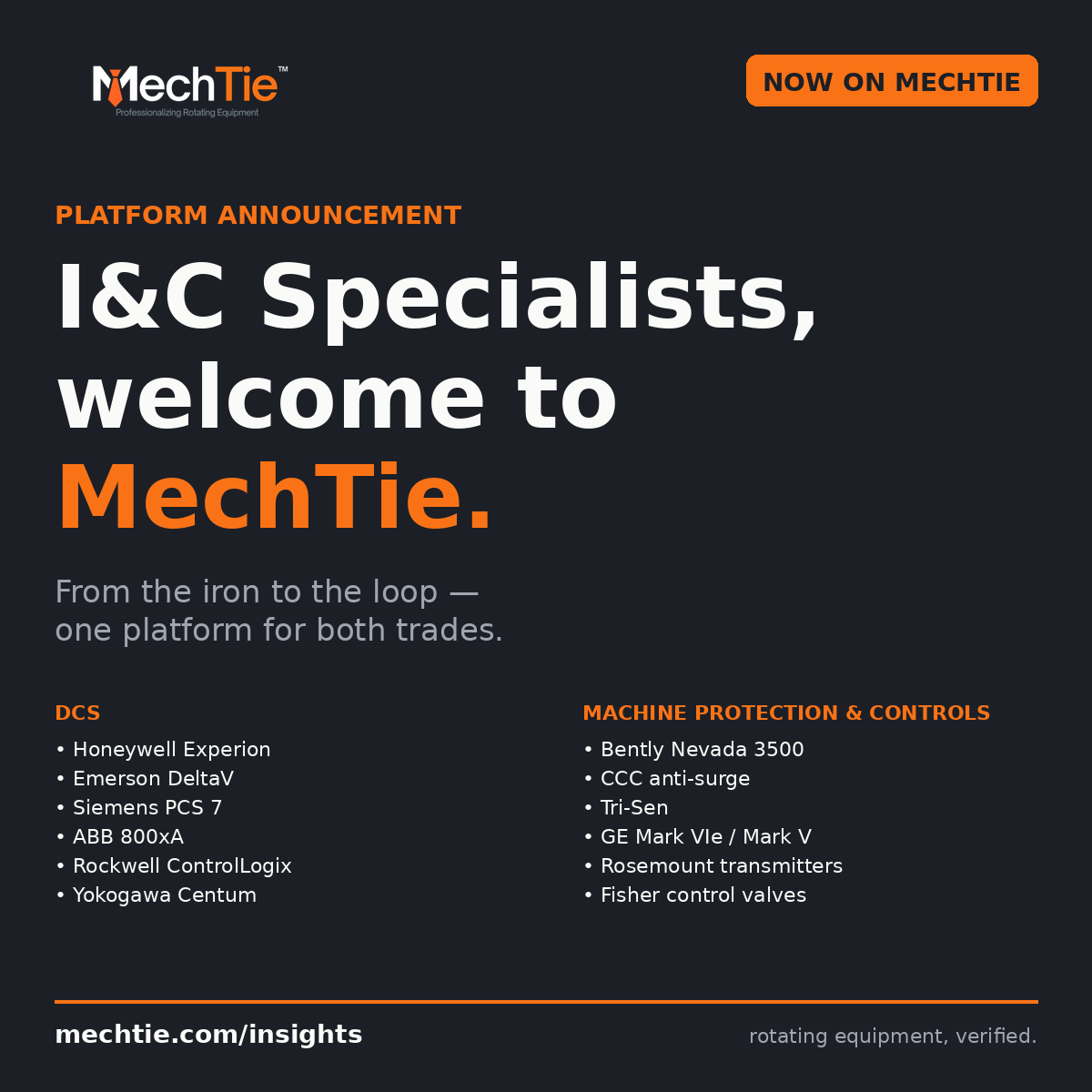
- Specific OEM coverage from day one: Honeywell Experion / Emerson DeltaV / Siemens PCS 7 / ABB on the DCS side; Rosemount / Endress+Hauser / Yokogawa / Fisher on field instruments; Bently Nevada 3500, CCC, Tri-Sen, and GE Mark VIe on machine protection and turbine/compressor controls.
- ISA CCST levels, factory authorizations, and SIS/SIL endorsements all show up as verifiable credentials on a specialist's profile.
- For plants: one verified short list for outages and turnarounds that need both rotating and I&C work. For specialists: your work crosses disciplines, and now your profile does too.
Why I&C, why now
Walk any modern compressor station, gas processing plant, refinery, or power island, and the instruments outnumber the iron. Every centrifugal compressor has a CCC or Tri-Sen anti-surge controller. Every steam turbine has a Mark VIe or a Woodward governor system. Every pump skid has a Rosemount transmitter or two and a Fisher control valve. The rotating equipment doesn't run without the loop, and the loop doesn't matter without the equipment underneath.
For years, the trades have been treated as separate. The mechanical side — turbomachinery techs, pump mechanics, millwrights — has its credentials, its OEM training, its certifications. The I&C side — instrument techs, controls engineers, automation specialists — has its own ISA tracks, factory training, and SIS work. Plants that need both for an outage often end up assembling them from different agencies, different employers, different verification standards.
That's the gap MechTie is closing. Starting today, instrumentation & controls specialists have full presence on the platform — same verification model, same equipment-specific work history, same peer endorsements that have been working for rotating equipment specialists since launch.
What's covered on day one
The platform is opening with three specialist domains:
DCS / PLC and process control
Honeywell Experion and TPS, Emerson DeltaV and Ovation, Siemens PCS 7 and Simatic S7, ABB 800xA and Symphony Plus, Rockwell Allen-Bradley ControlLogix, Yokogawa Centum. Specialists list specific platform versions, project history (commissioning, migration, expansion), and any factory authorizations they hold.
Field instruments and final control elements
Rosemount transmitters, Endress+Hauser flow and level, Yokogawa pressure and density, Fisher and Masoneilan control valves, Samson positioners. Calibration history, loop check experience, and SIS/SIL credentialing all show up as searchable profile attributes.
Machine protection and turbomachinery controls
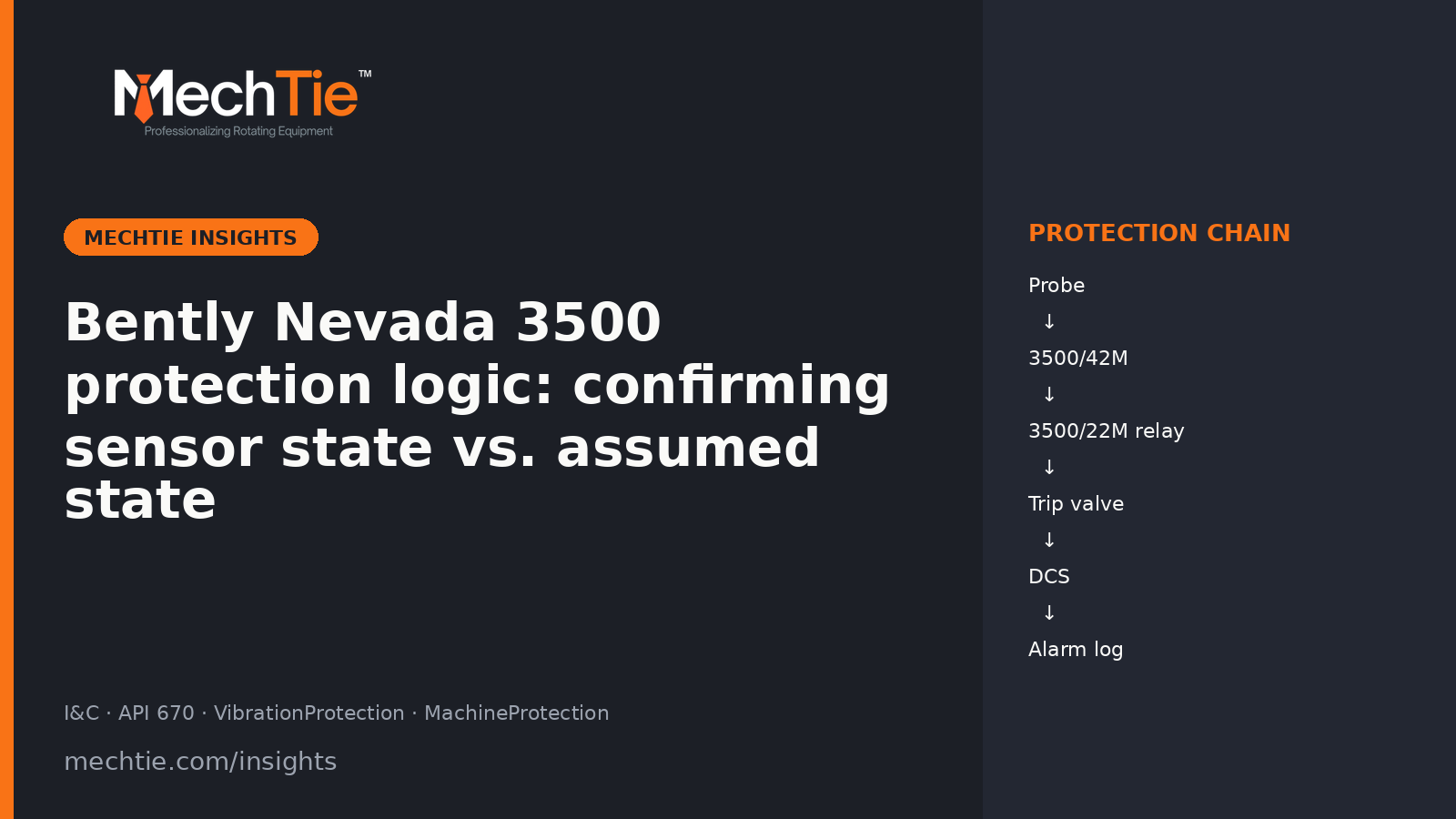
Bently Nevada 3500 and Orbit racks, GE Mark VIe and Mark V turbine controls, CCC compressor controls, Tri-Sen anti-surge, Woodward governors, Allen-Bradley/Rockwell mechanical drives integration. This is the bridge zone where I&C and rotating-equipment work overlap most directly — the same vibration signatures we cover in Reading a Coastdown Bode Plot Before You Trim Balance are exactly what the Bently rack reads and the DCS surfaces to the operator screen.
If you've worked on it, you can now claim it, verify it, and show it on your profile.
How verification works for I&C
The same workflow that has been protecting the integrity of rotating equipment profiles applies here.
Equipment work history
Each completed job logged against a specific platform — say, a DeltaV migration on a refinery FCC — adds to your verifiable history, with hours, scope (commissioning, troubleshooting, loop tuning, SIS proof test, etc.), and dates. Plants searching for "DeltaV migration specialist, Gulf Coast" find you because your record matches.
OEM authorizations
Honeywell, Emerson, Siemens, Rockwell, Yokogawa, ABB, Bently Nevada, GE — all major I&C OEMs have factory training and authorization paths. If you've been through them, the badges live on your profile, verified, and they travel with you, not your last employer.
Certifications
ISA CCST (I, II, III), TÜV functional safety engineer, ISA84 / IEC 61511 SIS, Cybersecurity Specialist (CCST levels), and the usual safety stack (TWIC, H2S Alive, OSHA 30, NFPA 70E) all integrate with Gate Pass for site access.
Peer endorsements
Same model as rotating: only specialists who actually worked alongside you on a verified job can endorse a skill. The endorser's own credentials are visible so plants can weigh the endorsement appropriately. No clickbait skill graphs, no anonymous boosts.
Why this matters for plants
The hardest position to staff during a major turnaround isn't usually the mechanical side — it's the techs who can connect the mechanical side to the controls. The compressor controls specialist who can also help re-tune anti-surge after a wheel change. The field instrument tech who knows which transmitter ranges actually matter on a pump skid. The Bently Nevada specialist who can walk a vibration trip event from sensor to rack to DCS to operator screen — and back to the bearing that triggered it.
Plants tell us the same thing: they end up making one of two compromises. Either they bring in two separate teams from two separate agencies and hope they communicate, or they staff with generalists who don't have the depth. Both options leave reliability on the table.
With I&C specialists now on the same platform, plants get one verified short list. The rotating equipment specialist with peer endorsements from the I&C techs they've actually worked with. The I&C specialist whose job history shows they've commissioned the exact CCC system on the exact compressor frame the plant runs. The crew with the documented track record together, not the rolodex of warm bodies.
This matters most where the disciplines overlap — pump skids that need both API 682 seal plan expertise and the I&C wiring that monitors the seal pot levels, or compressor trains where the mechanical alignment and the controls tuning have to be right together.
Why this matters for I&C specialists
Your work has always been adjacent to the rotating equipment trades. You were on the same skids, in the same control rooms, called for the same outages. The disciplines have always overlapped — and the credentials, certifications, and verifications have always been just as rigorous as those on the mechanical side.
Now the platform reflects that reality.
If you're an I&C specialist, here's what's worth doing in your first week on MechTie:
Build out your equipment list
Don't list "DCS." List Honeywell Experion R501 with three full migrations. List DeltaV v14 with five SIS commissionings. The specificity is what plants search for.
Add your factory authorizations
Every OEM badge you hold, with the date and the path. Make them verifiable.
Hook up your certifications
ISA CCST level, TÜV FSE, SIS / IEC 61511 work — these are credentials that command a premium for specific jobs, and they should be machine-readable on your profile, not buried in a resume PDF.
Endorse the rotating equipment specialists you've worked with
They're already on the platform. Their profiles get stronger when verified peers in the adjacent discipline vouch for them — and the same will happen for yours when they return the favor.
The bigger picture
The skilled trades don't have a labor problem. They have a visibility problem. Specialists who can do the work exist; they're just hard to find, hard to verify, and hard to source through the agency model that dominates today.
Every time MechTie expands the trades it covers — first rotating equipment, now I&C, more to come — the platform gets denser, the verifications get richer, and the short list a plant can pull together for any specific job gets sharper. The model is the same: peer-vouched, OEM-authorized, equipment-specific, and verifiable.
If you're an I&C tech reading this: welcome. The infrastructure your work depends on is the same as the rotating equipment specialists you've worked with for years. Now the way you get found, verified, and called for the next job is the same too.
Already on MechTie? Your existing profile keeps everything as-is — the I&C specialist domains are additive, not a migration. Just add the I&C credentials and equipment history if they apply to your work.
New to MechTie? Build your verified profile in under ten minutes →