Centrifugal Compressor Surge: Recognize It Before It Kills the Machine
Surge is a flow reversal across the impeller. The machine survives one or two. It doesn't survive a hundred - and once a controller is fighting surge unsuccessfully, you don't have much time.

Key takeaways
- Surge is a flow-reversal event across a centrifugal impeller — discharge gas blows back through the wheel because the head the impeller can produce drops below the system head at the operating flow.
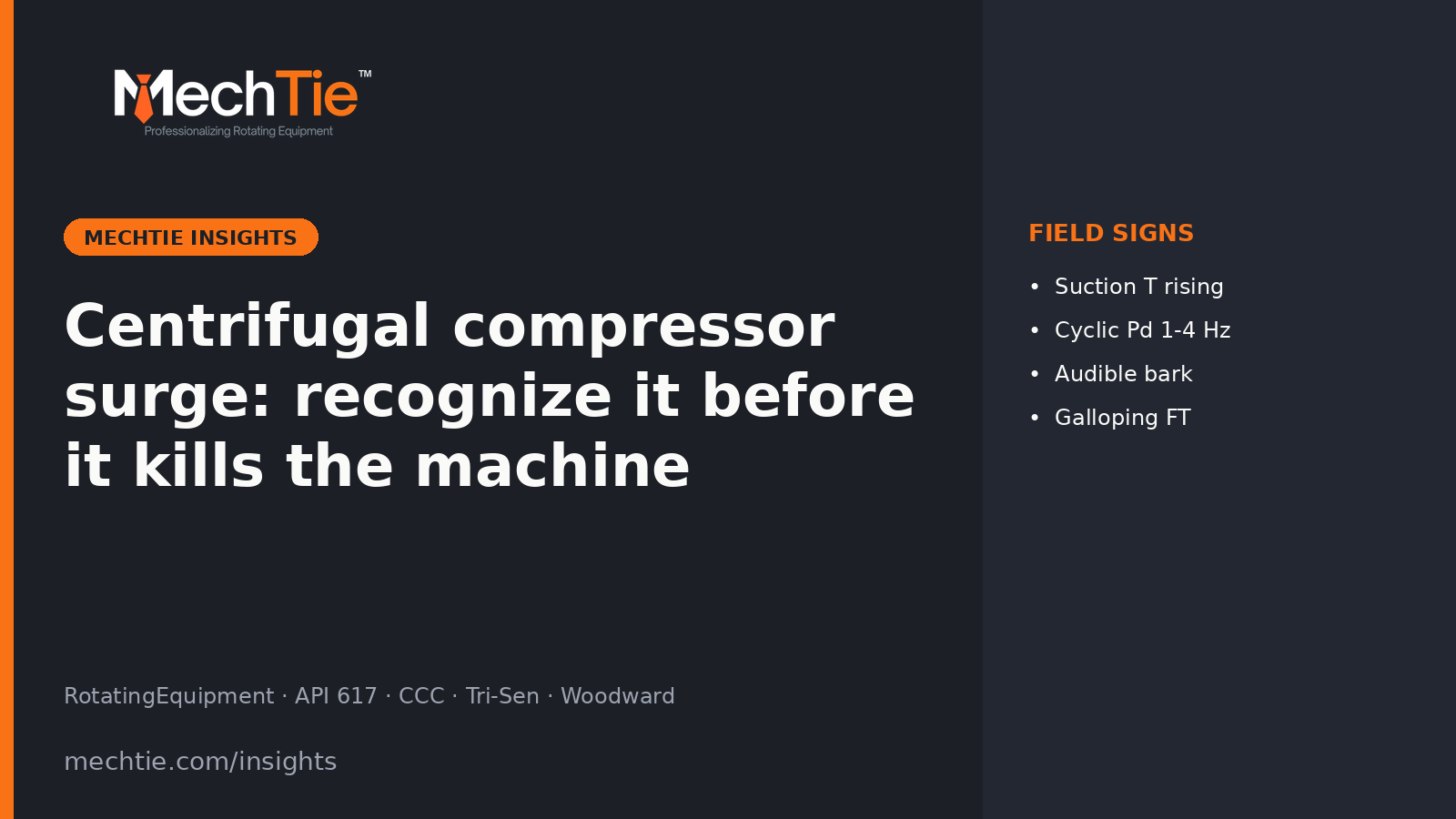
- The field signs that show up before the trip are not subtle once you know them: rising suction temperature, cyclic discharge pressure at 1–4 Hz, audible thumping or "barking" from the case, and a galloping reading on the discharge flow transmitter.
- Anti-surge controllers (CCC Series 5, Tri-Sen TS-1500, Woodward MicroNet) prevent surge by opening a recycle valve before the operating point crosses the surge line. The control loop runs in 20–50 ms; the surge event itself takes ~50–200 ms.
- Surge damage is cumulative. The wheel survives the first few events, but thrust bearings, labyrinth seals, and shaft journal coatings accumulate damage every cycle. Plants that "ride out a couple surge events" pay for it at the next outage.
- The most common controller failure modes in the field are not the controller - they're the inputs: a wrong PT, a fouled FT, an out-of-cal DP cell on the recycle valve, or a slow recycle valve actuator.
What surge actually is
Strip out the textbook language for a minute. A centrifugal compressor adds head to a gas by spinning a wheel. The wheel can only produce a certain amount of head at a given flow. The system the machine is pumping into demands a certain amount of head at a given flow. As long as the wheel head is above the system head, gas flows forward.
When flow drops, the wheel's head capability drops too — at some point on the curve, called the surge line, it falls below the system head. The downstream pressure pushes gas backward through the impeller, the wheel suddenly sees a different (lower) discharge pressure, it tries to push forward again, the cycle repeats. That's surge: a violent oscillation of forward and reverse flow across the impeller at 1–4 Hz, depending on the volume between the compressor and the first non-return valve.
The wheel is designed to spin gas in one direction. It does not like the reverse direction. Axial thrust loading flips. The thrust bearing — which is sized for unidirectional thrust - sees full reverse load. Labyrinth seals see reverse pressure gradient. The rotor sometimes axially shuttles enough to contact the labyrinth tips. None of these things are catastrophic on event one. They are cumulative.
The field signs before the trip
The plant operator's first warning is rarely the surge alarm. The early indicators show up minutes earlier, on instruments that aren't part of the protection system:
- Suction temperature climbing. When the recycle valve is open and the machine is pulling hot recycle gas, suction temperature rises 5–15 °F above its normal point. If you're walking the train and the suction-side gauge is warmer than it was an hour ago, ask why.
- Cyclic discharge pressure. Look at a 1-minute trend on the DCS. If discharge pressure is hunting up and down 5–10 PSI at 1–4 Hz, the operating point is on the boundary. It hasn't surged yet, but the controller is working hard.
- Audible thumping or "barking." A centrifugal in incipient surge sounds different from a healthy machine. Walking past the case, you'll hear a low-frequency thump or a bark on top of the normal whine. If you can hear it from 20 feet away, the machine is in trouble.
- Galloping flow indication. The flow transmitter on the suction or discharge will show fluttering values instead of a clean signal. On a healthy machine, FT signal noise is sub-1% of span. In approach to surge, you can see 5–10% of span swings.
By the time the high vibration trip or the high-temperature trip activates, the surge has been happening. The protection system is the last line, not the first.
Anti-surge control: how it actually prevents surge
Anti-surge control is one of the few control loops in a plant where the controller has to react faster than a human can perceive the event. The textbook implementation is straightforward, but the field implementation is where every plant has scars.
The controller monitors compressor operating point in flow-head space (or its proxies — suction flow, discharge pressure, suction temperature, suction pressure). It compares the operating point to a precomputed surge limit line that's been derated from the OEM surge curve with a safety margin. When the operating point crosses the surge control line (the surge limit line plus an additional margin), the controller opens a recycle valve to send compressed gas back to suction, increasing flow through the wheel and pulling the operating point back away from surge.
The dominant platforms in the field:
- CCC (Compressor Controls Corp.) Series 5 — the legacy industry standard. CCC is on most of the LNG and ethylene crackers built between 1990 and 2015. The flow-pressure-temperature-speed compensation in the CCC algorithm has decades of field tuning behind it.
- Tri-Sen TS-1500 / TS-3000 — strong presence in upstream gas processing and pipeline service. Tri-Sen tends to be specified when the EPC is doing the controls in-house rather than buying the OEM package.
- Woodward MicroNet / MicroNet TMR — common on gas turbine-driven trains where the same controller is doing fuel control and anti-surge.
The control logic on all three platforms is similar in principle. Where they differ is in how they handle multi-section machines (where you have a surge line per section), the speed of the recycle valve actuator they assume, and the cross-coupling between sections on shared recycle lines. We cover the architectural differences in detail in CCC vs. Tri-Sen anti-surge controls — what's actually different (publishing later this week).
What fails when anti-surge fails
Anti-surge controllers very rarely fail at the algorithm level. The dominant field failure modes are upstream of the controller, in the I/O:
- Recycle valve too slow. An anti-surge recycle valve has to stroke in 1–2 seconds, full close to full open. A standard globe-valve actuator can take 8–15 seconds. If the wrong valve is installed, the controller is doing the right thing and the valve is the problem. Field walkdown: confirm valve stroke time at the local panel.
- DP cell out of calibration on flow measurement. The controller's operating point is computed from the flow measurement. A 10% error on the DP cell shifts the operating point 10% on the curve — which can move you from "10% margin to surge" to "right on the surge line" without the controller knowing.
- PT fouled on suction. Suction pressure transmitter buried in oil or scale reads wrong. The pressure-ratio calculation is wrong. The surge line position is wrong. The controller is fighting the wrong fight.
- Speed signal noise on variable-speed trains. Anti-surge calculation depends on speed for the surge line shape. A noisy speed signal causes controller bouncing.
- Wrong surge map installed. Most often after a rotor swap or an impeller exchange. The surge line moved; the controller didn't. The first time the machine approaches the new surge boundary, it goes over.
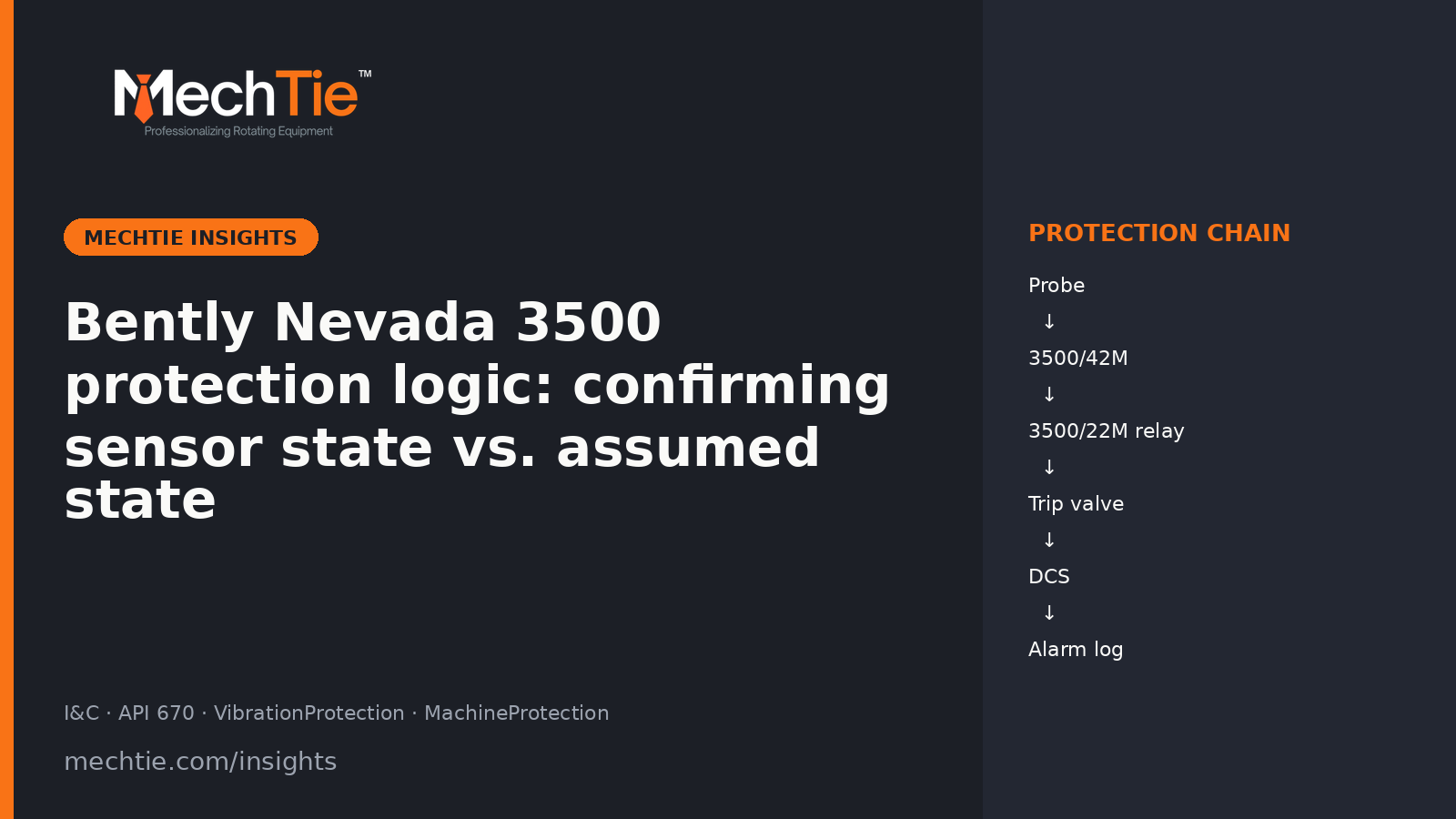
Every one of these is an instrumentation problem, not a controller problem. The discipline of confirming the inputs before tuning the controller is the discipline that separates technicians who can solve anti-surge problems from technicians who hand them off. We covered the same approach to confirming sensor state in Bently Nevada 3500 protection logic — confirming sensor state vs. assumed state.
The post-surge inspection nobody wants to do
A centrifugal compressor that has surged needs an inspection. Plants resist this because production pressure is real. The inspection scope at minimum:
- Thrust bearing pads. Pull the active and inactive thrust covers. Babbitt wipe, polished spots, and discoloration are the things you're looking for. A bearing that has seen reverse thrust will show a polished pattern on the inactive face that wasn't there before.
- Probe gap readings. Pull current proximity probe gaps and compare to the as-installed baseline. An axial position shift of 2–5 mils is consistent with thrust bearing wear; anything larger is failure.
- Labyrinth seal inspection. If the rotor shuttled enough to contact the labyrinth tips, you'll see rub marks on the tips. Borescope inspection through an available port is the minimum; full upper-half removal is the answer if you have time.
- Vibration baseline. Compare current vibration spectrum to baseline. New components at sub-synchronous or at running speed indicate developing problems that the surge accelerated.
If the plant has surged repeatedly without inspection, the failure is already loaded into the next outage budget. The thrust bearing is the most common failure mode 6–12 months after an unaddressed surge event.
The takeaway
Surge is preventable. It is preventable in real time by a working anti-surge controller with calibrated inputs and a fast recycle valve. It is preventable in slow time by a maintenance program that walks the I/O before it tunes the controller. And the early field signs — suction temperature, cyclic discharge pressure, audible barking, galloping flow — are visible to a competent operator or a walking mechanic before any alarm fires.
The plants that lose machines to surge are not the plants whose controller failed. They're the plants where nobody walked the suction PT in three years and the rotor was swapped without updating the surge map.
Are you a centrifugal compressor or anti-surge controls specialist? Build your verified MechTie profile — list the OEMs you've worked on (Dresser-Rand, Elliott, MAN Energy Solutions, Mitsubishi, Solar Turbines, Atlas Copco), the anti-surge platforms you've commissioned or troubleshooted (CCC, Tri-Sen, Woodward, Bently Nevada 3500), and your turnaround experience. Plants searching for surge-event response and anti-surge tuning find your name first.